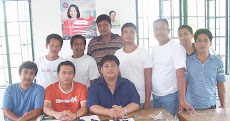
Si Barangay San Cristobal Chairman Benjamin "Benbong" Felismino II habang kasama ang kanyang pamilya nang ang mga ito'y namasyal at bumisita sa Enchanted Kingdom, Sta. Rosa, Laguna. Sa gitna ng malaking obligasyon at katungkulan bilang Punong Barangay ay nag-uukol ng ginuntuang sandali si Chairman Benbong para sa kanyang pamilya bilang sukli sa todo sup0rtang ibinibigay ng mga ito sa kanyang pagseserbisyo publiko.
Wednesday, August 27, 2008
ANG UNANG PAMILYA NG BRGY. SAN CRISTOBAL
Si Barangay San Cristobal Chairman Benjamin "Benbong" Felismino II habang kasama ang kanyang pamilya nang ang mga ito'y namasyal at bumisita sa Enchanted Kingdom, Sta. Rosa, Laguna. Sa gitna ng malaking obligasyon at katungkulan bilang Punong Barangay ay nag-uukol ng ginuntuang sandali si Chairman Benbong para sa kanyang pamilya bilang sukli sa todo sup0rtang ibinibigay ng mga ito sa kanyang pagseserbisyo publiko.

Saturday, August 23, 2008
VIEWPOINT (from: Philippine Daily Inquirer)
x x x Yet, S50 livelihood loans for poor women, to take one example, won the 2006 Nobel Peace Prize for Muhammad Yunus and Grameen Bank. “Micro-Credit is a means, whereby large population groups find ways to break out of poverty” the nobel citation said.
And that’s exactly how the CENTER FOR AGRICULTURE AND RURAL DEVELOPMENT MUTUALLY REINFORCING INSTITUTION (CARD MRI) won the 2008 MAGSAYSAY AWARD FOR PUBLIC SERVICE.
Starting with P20 in 1986, JAIME ARISTOTLE ALIP, Dolores Torres and Lorenza Bañez assisted landless women working in Laguna’s coconut plantations. Using Grameen methods, Laguna Borrowers guaranteed each other’s loans. They pledged to make loan payments and savings deposits every week.
The strategy worked. The women’s loan repayment rate is above 99 percent. The project’s return on equity is 12.5 percent on assets of S18 million, along way from the original P20 capital.
Today the project has 629 branches throughout the Philippines. More than half a million poor women are members. And two and a half million people are insured. Many are now self-employed, raising chickens, goats, or pigs, operating tricycles and street-side restaurants or working as tailors, market vendors and mini-storekeepers.
The center’s lending program provides livelihood-skills training. The project stresses individual responsibility. And its micro-insurance program serves as a safety net against emergency expenses, so often a catastrophe for the poor.
Despite striking progress, only a few have advanced to become “mature clients,” the citation notes. There are members who built income-generating businesses with over S2,200 in working capital. Each of these can employ from 5 to 15 workers.
“Most remain poor,” the Magsaysay Award citation says. “Even so, their lives are better because of CARD MRI. Even small addition to a family’s income can have profound consequences- for better housing, for better nutrition, and, most of all, for better education. Over time, these small benefits accumulate, securing and improving the lives of members and offering better hopes to the next generation.” X X X (Juan L. Mercado/PDI-August 19, 2008)
Thursday, August 21, 2008
DR. ALIP NG CARD BANK, NAGMULA SA BRGY. SAN CRISTOBAL


A group of 15 rural development practitioners organized the Center for Agriculture and Rural Development (CARD) Inc. as a social development foundation in December 1986 as a concerted response to the growing poverty incidence in depressed communities in Regions IV and V, particularly in the provinces of Laguna, Quezon, Mindoro Oriental, Mindoro Occidental, Marinduque, Masbate and the Bicol Region. Its vision has always been to establish a bank created for, owned and managed by landless rural women. In the words of CARD Founding President and now Managing Director, DR. JAIME ARISTOTLE B. ALIP, “Only by creating a vehicle for asset ownership, can we ensure that the poor will gain control over their own resources and over their own destiny.”
A training-focused community and livelihood assistance program for landless coconut workers marked the start of CARD Inc.’s operation in April 1988. In 1989, CARD Inc. pilot-tested solidarity group lending, modifying the Grameen Banking scheme to suit the context of the Philippines. Encouraged by the successful implementation of the model, CARD Inc. launched the Landless People’s Development Fund (LPDF) as its flagship program in 1990.The subsequent years were spent on refining the methodology, with the end view of achieving the twin goals of outreach and sustainability. In December 1995, the Board of Directors and management began discussing the transformation of CARD NGO into a bank to obtain the legal basis for mobilizing deposits from the public, and enable CARD Inc. to tap the commercial loan market.
In AUGUST 1997, CARD NGO obtained from the BANGKO SENTRAL NG PILIPINAS the LICENSE TO OPERATE AS A RURAL BANK IN SAN PABLO CITY, with an initial paid-up capital of Php 5 million ($167,000 US). Using a phased approach to transformation, 4 of 13 CARD NGO branches were converted into CARD Bank while the remaining branches continued to operate under CARD NGO. As a result of this strategy, CARD earned the recognition as the first microfinance NGO to transform into a formal financial intermediary, thus providing a model for other Microfinance Institutions (MFIs) in the country and abroad.
Answering the call for organizational renewal, CARD revisited its mission and vision in October 1999 and came up with a new mission statement: CARD is a group of mutually reinforcing institutions, that is dedicated to ultimately empower the poor, by upholding the core values of competence, culture of excellence, family spirit, stewardship and simplicity. By the year 2009, CARD’s existing structures will have been transformed into institutions that will serve as vehicles to provide more and better services to its clients, i.e. from CARD Rural Bank to CARD Development Bank; CARD NGO to CARD NGO Microfinance; CARD Training Center to CARD Development Institute; and CARD Mutual Benefit Association to CARD Insurance Company. As well, new institutions will have been created to respond to the evolving needs of CARD’s expanding clientele, namely the CARD Housing Development Company and CARD Marketing Centers.
In six years time, CARD MRI has already achieved its mission of transforming its Training Center into a Development Institute, the CARD MRI Development Institute (CMDI). However, as part of it mission of providing Marketing Centers, it has established the CARD Business Development Services (BDS).
CARD-MRI NI DR. ALIP NG SAN CRISTOBAL, 2008 RAMON MAGSAYSAY AWARDEE FOR PUBLIC SERVICE
 KARANGALAN NG SAN CRISTOBAL, KARANGALAN NG LUNSOD - Ang Center for Agriculture and Rural Development Mutually Reinforcing Institutions (CARD-MRI) na itinatag ni Dr. Jaime Aristotle B. Alip ng Brgy. San Cristobal ay ang itinanghal na 2008 Ramon Magsaysay Awardee for Public Service dahil sa katangi-tanging pagseserbisyo sa sektor ng micro-financing. Si Dr. Alip at ang kanyang mga magulang ay nagmula sa Barangay San Cristobal at isa sa mga naunang lahing naglingkuran upang maisakatuparan ang kawikaang: Kayang-kaya pag samasama at nagkakaisa.
DR ARISTOTLE ALIP - Founder and MRI Managing Director, Center for Agriculture and Rural Development (CARD) Mutually Reinforcing Institutions; CARD Bank, CARD NGO, CARD MBA (Insurance), and CARD Training Institute
The Center for Agriculture and Rural Development (CARD) is a microfinance institution that comprises both an NGO and a Bank, and is a replication of the Grameen Bank lending methodology.
CARD is the first NGO in the Philippines to transform into a bank with a total outreach of more than 301,000 poor families (focused on women clients) with an outstanding portfolio of US$20 Million.
CARD MRI has a total of 307 offices in the entire country with more than 1,500 staff.
CARD is a pioneer institution not only in microfinance but also in micro-insurance insuring more than 1,400,000 poor individuals.
CARD MRI has a total asset of US$ 30Million with liaison office in Cambodia and Partnership program in Hanoi, Vietnam
Some of his awards received:
2007 Most Outstanding Alumnus Award, UPLB – for being at the forefront of rural development in the public and private sectors
Most Distinguished Alumnus Award, UPLB – in recognition of the embodiment of what the Oblation means in thought, word, and deed
Ernst & Young Social Entrepreneur of the Year Philippines Award 2006 – for his contribution towards poverty alleviation
People Power People Award in 2005 for leadership and CARD’s work in microfinance.
Global Excellence Award in Microfinance (NY, USA, 2003)
Launched and spearheaded the national poverty alleviation program (KALAHI) when he was Undersecretary for Operations of the DWSD (Sept 2002-Oct. 2003), with US$100 M funding from the World Bank
Responsible for the Beneficiaries Development Program of the Dept. of Agrarian Reform when he was Assistant Secretary in April 1996 to June 1998.
Has served in the various key positions in the Philippine Government with commitment to the cause of the poor but pursues such mission with the highest professional standards and ethics.
Has affiliations with microfinance associations
Has written and published major articles on credit policy, community resource security and sustainable livelihood and the sustainability of credit for and by the poor.
2008 RAMON MAGSAYSAY AWARDEE FOR PUBLIC SERVICE
Center for Agriculture and Rural Development – Mutually Reinforcing Institutions
(of DR. JAIME ARISTOTLE B. ALIP)
DR. JAIME ARISTOTLE ALIP, NAMUMUKOD NA SAN PABLEÑO

San Pablo City – Kaugnay ng pagdiriwang ng ika-68 anibersaryo ng pagkakatatag ng Lunsod ng San Pablo, si Dr. Jaime Aristotle Alip ay napiling isa sa The Outstanding San Pableños.
Siya ay pinarangalan ng pangasiwaan ng Lunsod sa isang pagtitipon sa Coco Palace Hotel and Restaurant noong Martes ng gabi, kasama ng iba pang maipagmamalaking anak ng pamayanang kilala bilang Lunsod ng Pitong Lawa.
Si Dr. Alip ang nagsimula noong 1986 ng isang micro finance project sa Lalawigan ng Laguna na tinatawag na Center for Agricultural and Rural Development (CARD) upang makapagkaloob ng walang panagot na pautang na umaabot sa P2,000 upang maitulong sa mga mahihirap na mamamayan na matulungan ang kanilang sarili.
Ngayon, ang CARD Group of Companies ay 160,000 kliyente o natutulungan na ang nakararami ay kababaihan na matatagpuan sa lahat ng sulok ng bansa.
Umaasa si Alip na bago sumapit ang taong 2009 ay makakatulong na sila sa 1 milyong sambahayan sa pamamagitan ng pagpapahiram ng puhunan na halos ay walang patong na tubo.
Ang kanilang mga kliyente ay sinasanay sa wastong pagbibili ng ano mang artikulo ng kalakalang kanilang malilikha, pangangasiwa ng kanilang munting negosyo, pagpapaunlad ng produktong sandigan ng kanilang hanapbuhay at iba pang kamalayan tungo sa ikapagtatagumpay ng pamumuhunan.
Si Dr. Alip ay tumanggap na ng mga pagkilala at pagpapahalaga mula sa mga lider ng mga papaunlad na bansa dito sa Asia na nakikinabang sa kanyang micro-financing project, at ang kauna-unahang pagkilala sa kanya ay kaloob ni Pangulong Corazon C. Aquino. (THE WEDNESDAY HERALD, May 7-13, 2008, vol. XXVII No. 36)
Tuesday, August 19, 2008
ST. CHRISTOPHER'S MARTYRDOM

Saint Christopher is a saint venerated by Roman Catholics and Orthodox Christians, listed as a martyr killed in the reign of the 3rd century Roman emperor Decius (reigned 249-251).
The Eastern Orthodox Church venerates Saint Christopher on May 9. the Tridentine Calendar allowed a commemoration of Saint Christopher on 25 July only in private masses. The restriction was lifted after (see General Roman Calendar as in 1954). While the Roman Catholic Church still approves devotion to him, listing him in the Roman Martyrology among the saints venerated on 25 July, it removed his feast day from the Roman Catholic calendar of saints in 1969. At that time the church declared that this commemoration was not of Roman tradition, in view of the relatively late date (about 1550) and limited manner in which it was accepted into the Roman Calendar.
According to legend, during the reign of the Emperor Decius, a man named Reprebus or Reprobus (root of English word “reprobate”) was captured in combat against tribes to the west of Egypt and was assigned to the numerus Marmaritarum or “Unit of the Marmaritae” which suggests an otherwise-unidentified “Marmaritae” Berber tribe of Cyrenaica. He was of enormous size and terrifying demeanour. Reprebus accepted baptism and began to preach the faith. Eventually, the governor of Antioch (or in some versions the Emperor himself) decreed that Reprebus was to be executed for his faith. He miraculously survived many attempts at execution, eventually permitting himself to be martyred after converting multitudes. His body was then taken back to Alexandria by Peter of Attalia.
Monday, August 18, 2008
ST. CHRISTOPHER: HISTORICAL VERIFIABILITY


The first hurdle is the idea that he was a dog-headed cannibal. This can be understood in the light of the practice of the time, which was to describe all people outside the “civilized” (Greco-Roman-Persian) world as cannibal, or dog-headed albeit metaphorically. A later generation could then mistake a metaphor or hyperbole for a literal statement.
The man in question is also said to have been assigned to a military unit made up of Marmaritae. The Marmaritae were the independent tribes of Marmarica (now in modern Libya), who would have pushed to the frontier region after Roman settlement. Since he was from a frontier tribe, describing him as being from the land of dog-headed people would have been a literary convention of the day.
The various miracles attributed to him could be explained as ordinary embroidering typical of hagiography, especially regarding saints of the early centuries of Christianity.\
Finally, we have the statements that he was killed in Antioch and his body taken elsewhere by a bishop. St. Christopher could not have been killed in the fourth year of the Emperor Decius, as Decius only reigned for two years, however, before ascending to the throne of the Eastern Roman Empire, Maximinus was known as “Daza” before rising to power. Unfortunately, there is no record of a visit to Antioch by Maximinus in the fourth year of his reign (308). It is, of course, possible that St. Christopher was executed in Antioch during this year by the order of a lower authority; a personal trial before one of the Caesars could be a later embellishment.
Unfortunately, none of this information permits identification of the actual man. CHRISTOPHER is simply greek for “CHRIST-BEARER”, and it can refer, as in the Eastern tradition and in Jacobus de Voragine’s explanation of the name, to St. Christopher’s willingness to “TAKE UP THE CROSS” – a common metaphor for converting to Christianity . “Reprobuz” simply means “wicked person”, so saying that “Reprobuz” became CHRISTOPHER amounts to saying “A WICKED PERSON BECAME A CHRISTIAN”. Furthermore, no place claims to be the burial site of St. Christopher, which would be very unusual for a martyr.
It has been speculated that St. Christopher could be the same man known as “Saint Menas” among the Copts, for whom a 4th century burial site is known but has no verifiable details about his life or martyrdom attached to him. However, there is no conclusive link.
Subscribe to:
Posts (Atom)